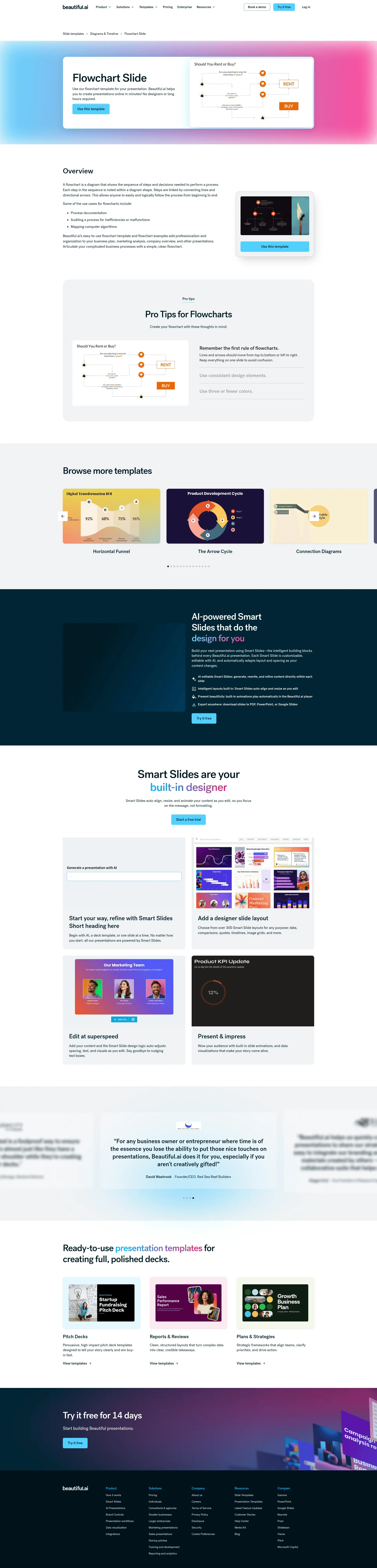
Two views of the same set of changes. Optimization Draft is the standard draft view, with the full before/after copy for every element in live page order and the paste-ready schema package. Annotated Before & After lays the same changes over a screenshot of the live page at beautiful.ai/templates/flow-chart, taken August 24; click a numbered marker to jump to its card. The full module spec behind every change is on the review hub.
| Page URL | https://www.beautiful.ai/templates/flow-chart |
| Category | Diagrams & Timeline (breadcrumb: Slide templates › Diagrams & Timeline › Flowchart Slide) |
| Head Term | flow chart template |
| GSC Baseline | #36.7 for “flow chart template” (90 days) |
| Proposed Title Tag | Flow Chart Template for Presentations | Beautiful.ai (52 chars) |
| Proposed Meta Description | Start from a designer-made flow chart template, add your steps by hand or let AI fill it in, then take the finished slide to PowerPoint or Google Slides. (153 chars) |
| Summary | The live H1 is “Flowchart Slide” and the page has a single Pro tips tab. At #36.7 for “flow chart template,” the head term enters the title, meta, and H1, the tab content un-nests into a stacked section, and the new modules follow the batch pattern. |
Why: The live H1 is “Flowchart Slide,” which neither matches the head term’s spelling nor says “template.” This is the largest H1 gap in the batch.
Use our flowchart template for your presentation. Beautiful.ai helps you to create presentations online in minutes! No designers or long hours required.
A designer-made flow chart template that’s fully editable. Add your steps and decisions by hand or let AI fill them in, and Smart Slides keep the connectors aligned as you edit.
Why: The live subhead is the boilerplate. The new one names what the template holds: steps, decisions, connectors.
Use this template
Use this template (kept, primary) + Fill it in with AI (new, secondary)
Why: “Use this template” matches what the searcher came for and stays primary. AI fill is the differentiator no printable or vector template site on this results page can offer, which earns it the secondary slot.
A band of static previews of this template in multiple slide themes, each opening the editor. The existing walkthrough video keeps its tile in the band and still plays on click.
Why: Every winner on this results page opens onto a gallery of editable variants; this page shows one chart behind a video embed.
Why: The how-to carries the AI fill capability in step two as well. Every step is a documented product behavior.
Why: The overview copy is real, useful content and stays. The heading becomes the question searchers actually ask, and the block moves down so the page leads with what the searcher came for: the template.
A flowchart is a diagram that shows the sequence of steps and decisions needed to perform a process. Each step in the sequence is noted within a diagram shape. Steps are linked by connecting lines and directional arrows. This allows anyone to easily and logically follow the process from beginning to end.
Some of the use cases for flowcharts include:
Beautiful.ai’s easy-to-use flowchart template and flowchart examples add professionalism and organization to your business plan, marketing analysis, company overview, and other presentations. Articulate your complicated business processes with a simple, clean flowchart.
Why: The overview copy is real, useful content and stays word for word; only the heading changes and the block moves below the new template layer.
Only a “Pro tips” tab exists on this page; there is no “Discover AI capabilities” block, and the single tab still renders inside the tab component.
Pro tips kept in full, laid out as a stacked section, and a new Discover AI capabilities section is added beneath it with this page’s nouns, so the page matches the rest of the template family. The how-to (marker 8) and FAQ (marker 13) still carry the AI fill copy.
Why: The CMS template supports the AI pane but this page never got one. The added section instantiates the family’s documented AI behaviors with flow chart nouns, keeping the library uniform.
Create your flowchart with these thoughts in mind:
Remember the first rule of flowcharts. Lines and arrows should move from top to bottom or left to right. Keep everything on one slide to avoid confusion.
Use consistent design elements. Shapes, lines, and texts within a flowchart diagram should be consistent to make the diagram simple to read. Make your start and end points slightly bigger.
Use three or fewer colors. Be sure to use colors that match to make your flowchart easy to grasp. For example, use 3 different shades of blue.
Why: Every tip above ships unchanged; only the layout un-nests so the copy is visible without a click.
With these AI-driven features, you can build and refine your flow chart slide in seconds.
Generate an AI flow chart with a prompt. Prompt the AI assistant with the process you’re mapping and watch the flow chart come together automatically.
Add context with AI. Add documents or data to your prompt and the AI will use that material to generate a flow chart that fits your story.
Refine copy on a flow chart slide. Leverage AI to edit text within the slide: create new text from a prompt, rewrite existing text, or expand and shorten its length.
Use AI to create speaker notes. The AI assistant can generate speaker notes from scratch, pulling from the content on your slide.
Why: The live page is one of the few in the template family without the AI-capabilities pane, and the library reads as one system when every page carries it. Every behavior in this copy is documented on the family pages that have the pane; only the nouns are this page’s own.
Fifteen autoplaying Vimeo embeds from the Diagrams & Timeline category, Horizontal Funnel through Process Diagram, each with a generic “View template” link.
Static image cards with descriptive text links, “Timeline template,” “Process diagram template”, with videos still available on click.
Why: At fifteen autoplaying embeds, this carousel ties the timeline page for the largest in the batch. Static cards with real anchors keep the breadth and cut the load cost.
Is the flow chart template editable?
Yes. The template is a fully editable Smart Slide: add steps and decision points, relabel shapes, and redraw connectors, and the layout stays aligned as you work.
How do I add my own steps?
Open the template and type in each step, decision point, and the connectors between them, or upload a document or data file and Beautiful.ai places your process on the slide.
Can AI fill it in for me?
Yes. Describe the process, and the AI assistant fills the template with steps, decisions, and connectors in place. You can keep editing everything afterward.
Can I export to PowerPoint or Google Slides?
Yes. Slides export to PowerPoint, Google Slides, or PDF, and you can also present or share a live link directly from Beautiful.ai.
When should I use a flow chart?
A flow chart works best when a process needs to be followed step by step: process documentation, auditing a process for inefficiencies, or mapping computer algorithms. Each step sits in a shape, linked by connecting lines and directional arrows.
Why: The FAQ’s AI answer restates the capability in crawlable prose. Answers are product facts; none claims the template is free.
“More diagram & timeline templates”: every same-category sibling linked with a descriptive anchor (Timeline template · Process diagram template · Customer journey map template · Hub and spoke template …), plus the slide templates hub and the presentation software page.
Why: The Diagrams & Timeline cluster is fifteen pages linked today only by “View template” labels. Head-term anchors make it crawl like a connected system.
The Smart Slides band, testimonials, template gallery band, and footer CTA below the carousel are site-wide template chrome, shared by every page on the site, and are unchanged.
| Title tag | missing → carries the head term |
| Meta description | missing → carries the head term |
| H1 | missing → carries the head term |
| How-to H2 + HowTo schema | missing → carries the head term |
| FAQ H2 + FAQPage schema | missing → carries the head term |
[
{
"@context": "https://schema.org",
"@type": "BreadcrumbList",
"itemListElement": [
{
"@type": "ListItem",
"position": 1,
"name": "Slide templates",
"item": "https://www.beautiful.ai/slide-templates"
},
{
"@type": "ListItem",
"position": 2,
"name": "Diagrams & Timeline"
},
{
"@type": "ListItem",
"position": 3,
"name": "Flow Chart Template",
"item": "https://www.beautiful.ai/templates/flow-chart"
}
]
},
{
"@context": "https://schema.org",
"@type": "HowTo",
"name": "How to use the flow chart template",
"step": [
{
"@type": "HowToStep",
"position": 1,
"name": "Open the template.",
"text": "“Use this template” opens it in the Beautiful.ai editor."
},
{
"@type": "HowToStep",
"position": 2,
"name": "Add your steps.",
"text": "Type in each step, decision point, and the connectors between them, upload a document or data file, or describe the process and let AI fill the template."
},
{
"@type": "HowToStep",
"position": 3,
"name": "Make it yours.",
"text": "Adjust colors and labels; Smart Slides keep the layout aligned as you edit."
},
{
"@type": "HowToStep",
"position": 4,
"name": "Present or export.",
"text": "Share a live link, present in Beautiful.ai, or export to PowerPoint, Google Slides, or PDF."
}
]
},
{
"@context": "https://schema.org",
"@type": "FAQPage",
"mainEntity": [
{
"@type": "Question",
"name": "Is the flow chart template editable?",
"acceptedAnswer": {
"@type": "Answer",
"text": "Yes. The template is a fully editable Smart Slide: add steps and decision points, relabel shapes, and redraw connectors, and the layout stays aligned as you work."
}
},
{
"@type": "Question",
"name": "How do I add my own steps?",
"acceptedAnswer": {
"@type": "Answer",
"text": "Open the template and type in each step, decision point, and the connectors between them, or upload a document or data file and Beautiful.ai places your process on the slide."
}
},
{
"@type": "Question",
"name": "Can AI fill it in for me?",
"acceptedAnswer": {
"@type": "Answer",
"text": "Yes. Describe the process, and the AI assistant fills the template with steps, decisions, and connectors in place. You can keep editing everything afterward."
}
},
{
"@type": "Question",
"name": "Can I export to PowerPoint or Google Slides?",
"acceptedAnswer": {
"@type": "Answer",
"text": "Yes. Slides export to PowerPoint, Google Slides, or PDF, and you can also present or share a live link directly from Beautiful.ai."
}
},
{
"@type": "Question",
"name": "When should I use a flow chart?",
"acceptedAnswer": {
"@type": "Answer",
"text": "A flow chart works best when a process needs to be followed step by step: process documentation, auditing a process for inefficiencies, or mapping computer algorithms. Each step sits in a shape, linked by connecting lines and directional arrows."
}
}
]
},
{
"@context": "https://schema.org",
"@type": "VideoObject",
"name": "Flow Chart Slide Template",
"description": "Walkthrough of the flow chart template Smart Slide in Beautiful.ai.",
"embedUrl": "https://player.vimeo.com/video/395313352"
}
]Why: All four blocks generate from the same per-page content slots, so they scale mechanically across all 236 pages. The existing schema block’s url host gets aligned to www.beautiful.ai. The VideoObject covers the kept hero video; its thumbnailUrl comes from the client’s own video-indexing pipeline, which owns poster assets.